ESG did not begin as a reporting trend
Environmental, social and governance considerations emerged from a long sequence of economic, environmental and institutional developments. Industrial growth created prosperity, but also revealed the costs of pollution, unsafe work, resource depletion and weak accountability. Over time, governments, investors, consumers and communities began asking a broader question: how does an organisation create value, and who bears the cost when that value is created poorly?
The modern ESG agenda is therefore best understood as a governance response to interconnected risk. It brings non-financial matters into the decisions that shape strategy, capital allocation, operations and long-term resilience.
From social responsibility to investment discipline
Corporate social responsibility initially focused on ethics, philanthropy and voluntary commitments. These activities were valuable, but they often sat outside core management systems. Responsible investment moved the discussion closer to enterprise value by asking whether environmental exposure, labour practices, board effectiveness and business conduct could influence financial performance.
The term ESG helped organise these issues into three connected dimensions:
- Environmental: climate, energy, emissions, water, materials, waste, biodiversity and environmental compliance.
- Social: people, health and safety, human rights, customers, communities and the supply chain.
- Governance: leadership, accountability, ethics, risk, controls, transparency and decision rights.
These dimensions are not separate programmes. Governance determines how environmental and social commitments are translated into priorities, responsibilities, resources, controls and evidence.
Why the agenda accelerated
Several forces brought ESG into mainstream management: climate-related disruption, global supply-chain exposure, rising disclosure requirements, investor demand for comparable information and public scrutiny of corporate conduct. Frameworks and standards then improved the language used to describe risks, impacts and performance.
This evolution also exposed a recurring weakness. Organisations could publish ambitious statements while their operating systems remained fragmented. Data might be collected for a report without clear ownership, controls or links to decisions. ESG then became a communications exercise rather than a management capability.
ESG as a management system
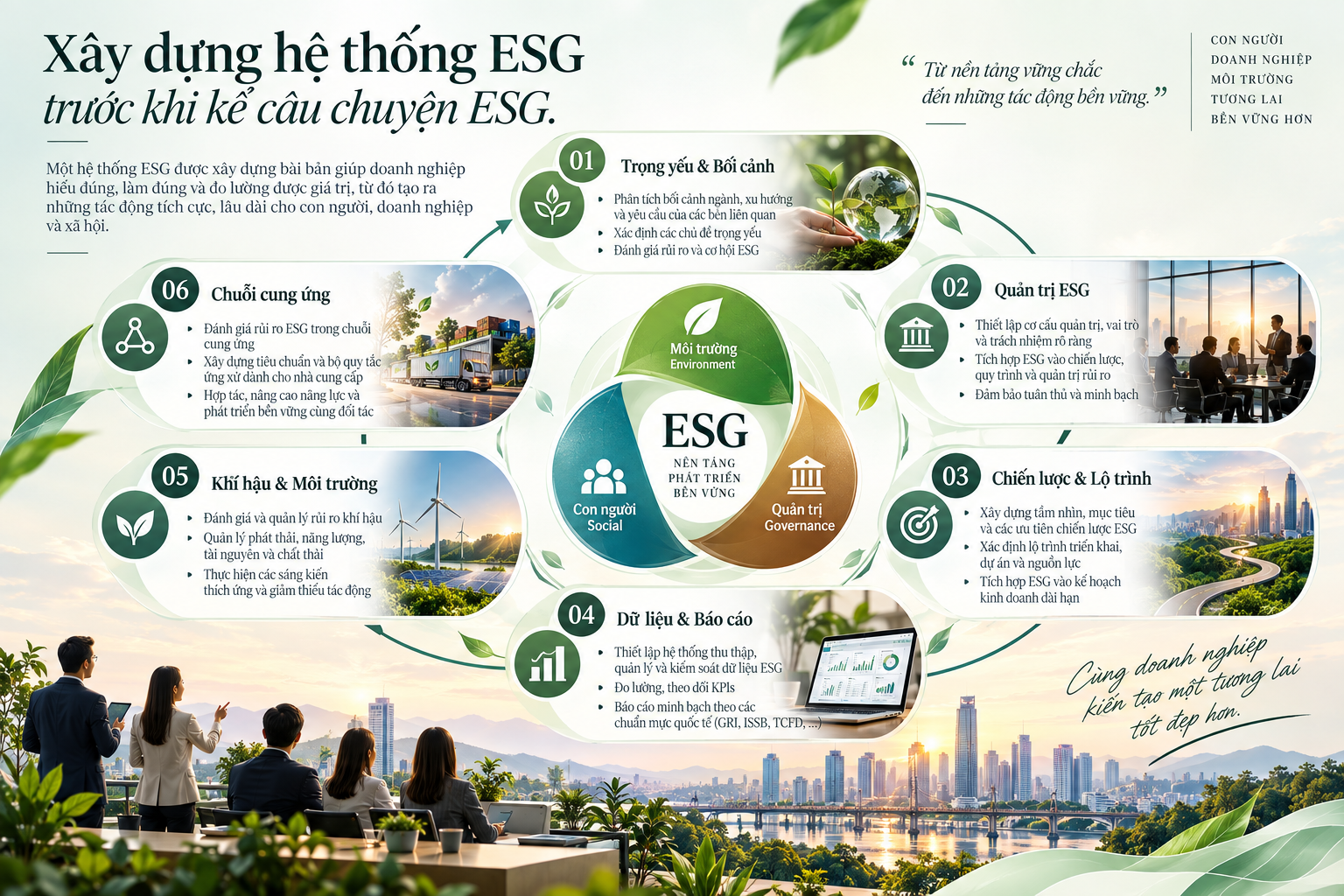
A credible ESG approach begins with context and materiality. The organisation identifies the sustainability matters that could affect enterprise value and the impacts its activities may have on people and the environment. It then establishes governance, strategy, objectives, data architecture, controls, monitoring and review.
In practical terms, ESG should connect with the organisation’s existing architecture: enterprise risk, finance, operations, quality, food safety, procurement, human resources, information systems, compliance and management review. Integration avoids creating another silo and makes ESG part of normal decision-making.
A practical foundation
Organisations beginning their ESG journey should focus on five foundations:
- Context and materiality: understand the business model, value chain, stakeholders, risks and impacts.
- Governance: define oversight, executive accountability, operational ownership and escalation routes.
- Strategy and roadmap: translate material matters into priorities, targets, initiatives and resources.
- Data and controls: define metrics, owners, sources, calculation methods, evidence and assurance controls.
- Performance and review: integrate ESG into dashboards, risk reviews and leadership decisions.
ESG is ultimately a way of governing an organisation under wider expectations of responsibility and resilience. Its value does not come from the label itself, but from the quality of the management system behind it.
← Return to Insights